Gomoku Strategy: Threats, Forks and Defence
Good gomoku strategy is mostly about threats: make shapes your opponent has to answer until one move makes two at once. This guide covers openings, the shapes that matter, the four-three fork and defence, with real boards from Starlay.
Play Starlay gomoku nowToday’s puzzle
Start with the centre, and expect to defend
On a 15x15 board with freestyle rules, the player who moves first can force a win with perfect play, a result proven by computer search in the 1990s. Humans do not play perfectly, so the practical gomoku strategy is simpler. As Dark, open in the middle, where each stone belongs to the most possible lines. As Light, put your first stone right next to Dark's, so that your stones sit inside Dark's lines instead of drifting to the edge.
Stones near the border have fewer directions to grow in. A line that runs into the edge is closed at that end, which makes it much weaker.
The shapes: threes, fours and forks
Almost every game is decided by a handful of shapes.
- Open three: three stones with free crossings at both ends. It threatens an open four next turn, so it demands an answer.
- Closed three: one end is blocked. It is not urgent, but it can still become a four.
- Four: one stone from five. The opponent must block at once, and that forced reply gives you the tempo.
- Open four: both ends free. This cannot be stopped.
- Split three: two stones, a gap, then a stone. Fill the gap and you have an open four, so treat it like an open three.
The skill is to chain forcing moves, so every stone you place gets a forced reply, until one move creates two threats at the same time.
Winning gomoku strategy: the four-three fork
The strongest single idea is the four-three. One stone completes a four on one line and an open three on another. The opponent must block the four, and then you turn the three into an open four.
Here is a real position from a two-player game in Starlay. Dark has three stones in a row on the left, with Light already blocking the far end, and two more stones stacked above the right-hand end.
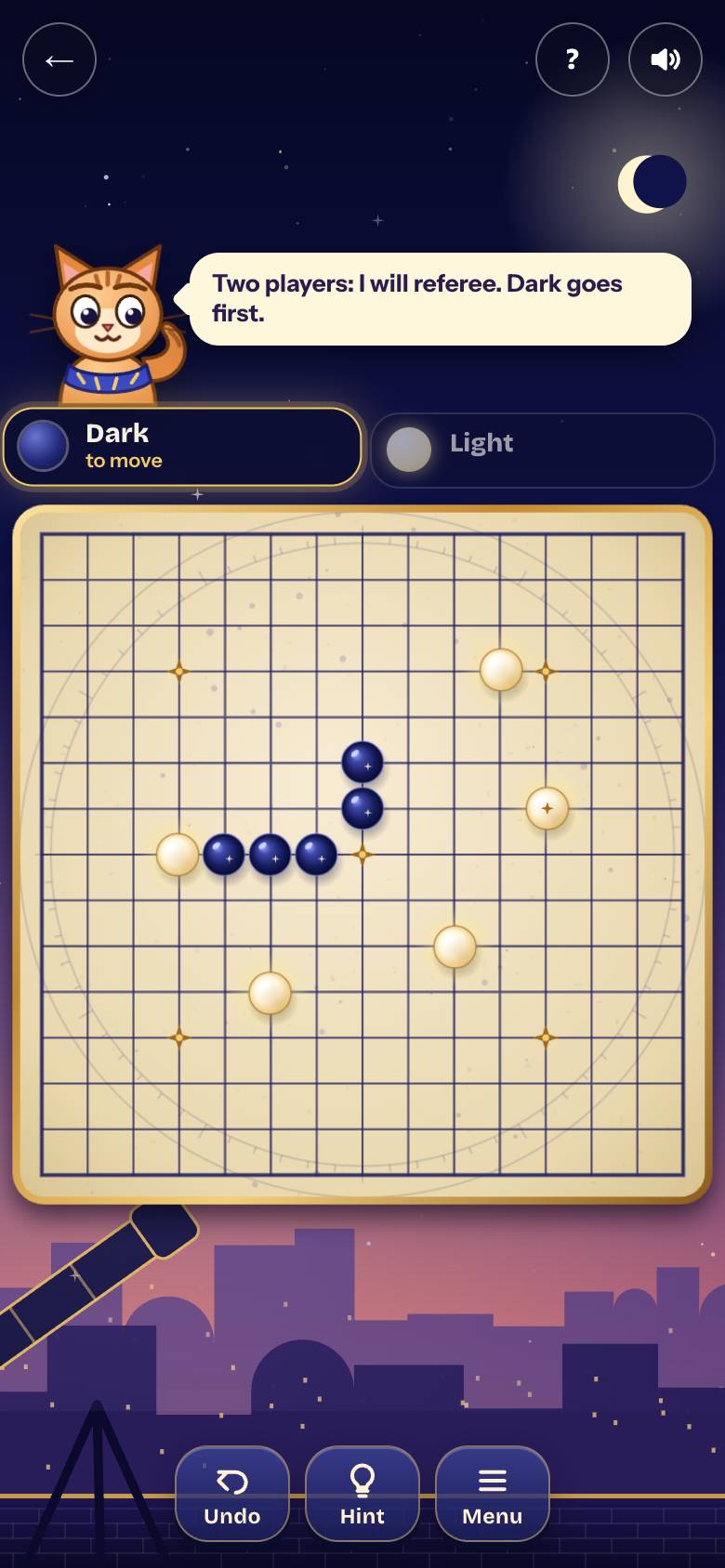 Dark to move. Which crossing does two jobs?
Dark plays at the right-hand end of the row. That makes a four, because the left end is blocked but the right end is free, and a vertical three with space above and below. Nova calls it a double threat, and a red ring marks the crossing Light must take.
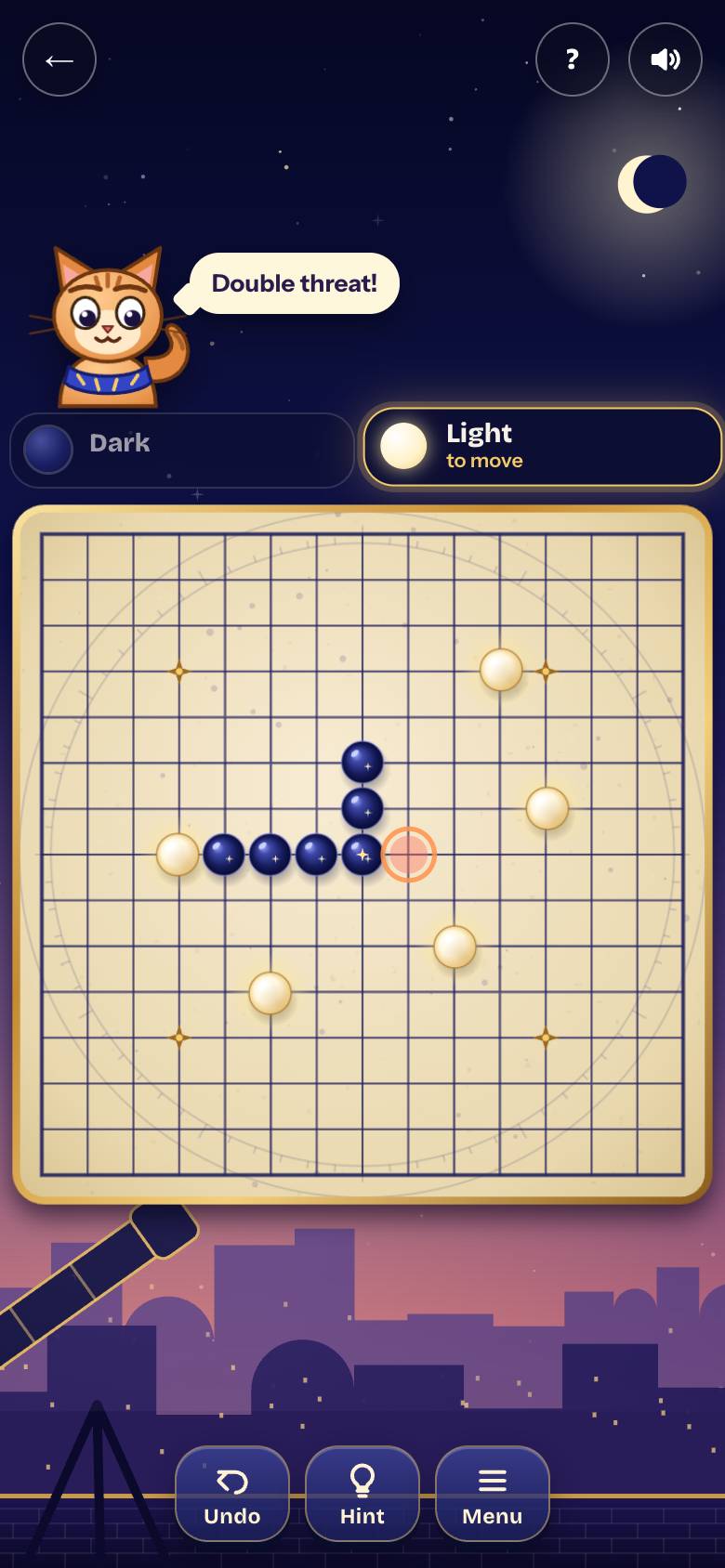 After the four-three: Light must take the ringed crossing, then Dark extends the column to an open four.
To build your own forks, look for two lines that cross at an empty crossing, each already holding two or three stones. Place stones that quietly prepare that crossing before the opponent notices.
Defence: how to stop threats early
Good defence is about seeing the fork before it happens.
- Answer a four immediately. Nothing else matters if your opponent can complete five next turn.
- Block an open three on the end that helps you. Choose the side that also extends your own line or blocks a second line.
- Take the fork crossing. If two of their lines cross at an empty point, occupy it before they do.
- Check diagonals. Slanted threes are the ones most often missed.
- Counter with a four only if it works. A four forces a reply and can win tempo, but a wasted four hands the opponent a free stone.
Starlay helps while you learn: the crossing that would complete five pulses red, and the first time an open three or four appears Nova explains it in a speech bubble.
Common mistakes to avoid
- Placing every stone in one line, so the opponent needs only one block.
- Ignoring a split three because it does not look like three in a row.
- Playing near the edge, where lines are closed.
- Building forks too late, after the opponent has already blocked both lines.
- Forgetting the rule choice: under Standard rules, a line that accidentally joins into six does not count.
Practise each idea on real boards
Gomoku strategy sticks faster when you solve positions. The daily puzzle offers three win-in-N tiers, from a four that sets up a double threat to a long run of fours. The 44-level campaign introduces open fours, double fours, four-three wins and double threes in order, and includes defence levels where you must block. When you want to review the basics first, the gomoku rules page has five lessons you can play on a small board.
Then take Nova on at Easy to practise forks, and move up to Medium and Hard once you find yourself winning. Easy blocks fours but misses plans, Medium scores patterns and blocks open threes, and Hard reads fours and forks ahead, so against Hard a single open three will rarely be enough.
Gomoku strategy questions
Is there a winning strategy in gomoku?
For freestyle on a 15x15 board, yes: the first player has a forced win with perfect play. Nobody plays perfectly by hand, so what you actually need is to make threats that force replies and to spot your opponent's forks.
What is the best first move?
The centre crossing. A stone there has the most open lines in every direction, and it keeps your later threats far from the edges.
How do I beat the computer in gomoku?
Do not rely on a single open three, because a computer blocks it. Prepare two lines that cross at an empty crossing, then play there for a four-three. Starlay's Easy level misses plans, so forks work well there.
What does four-three mean?
It is a move that makes a four and an open three at once. The opponent must block the four, which leaves the three free to become an open four.
Do Freestyle and Standard rules change the strategy?
A little. Under Standard rules only exactly five wins, so you must avoid completing six, and an opponent may use that when you join two lines across a gap. The threats and forks are otherwise the same.
How can I practise gomoku strategy?
Solve the daily puzzle and the campaign levels, which are all positions with a forced win, and play full games against Nova. The puzzles are built around fours and four-three wins.