Gomoku Rules: How to Play Five in a Row
The gomoku rules fit in one sentence: two players take turns placing stones on a grid, and the first to make an unbroken line of five wins. This page covers the exact rules Starlay uses, the two win options and five short lessons you can play below.
Play Starlay gomoku nowToday’s puzzle
Five tap-along lessons on a small board. Open the lessons full screen.
The board, the stones and who goes first
Starlay plays gomoku on a 15x15 board: fifteen lines across, fifteen down, 225 crossings in all. Stones sit on the crossings, not inside the squares. One player is Dark and the other is Light, and Dark always moves first. On an empty board Dark may open on any crossing, and the centre is the usual choice. After that the players alternate, one stone per turn.
Once a stone is down it stays down, because none of the gomoku rules involve moving or capturing. Nothing is taken off the board, so every move is permanent and the position only ever fills up. If all 225 crossings are taken and nobody has five, the game is a draw.
How to play gomoku in five steps
- Choose your colour. Dark opens, Light answers. Against the computer you pick a side on the setup sheet, and if you take Light, Nova places the first stone.
- Place a stone each turn. On a phone, tap a crossing to see a ghost stone and a magnifier, then tap it again or press Place stone. With a mouse, click.
- Build a line. A line can run across, down or on either slant. It must be unbroken: five of your stones side by side, with no gap and no opposing stone in between.
- Watch the red ring. When a player is one stone from five, the finishing crossing pulses red. Block it or use it.
- Make five to win. The first player to complete a line wins on the spot. In Starlay, a finished line lights up as a constellation.
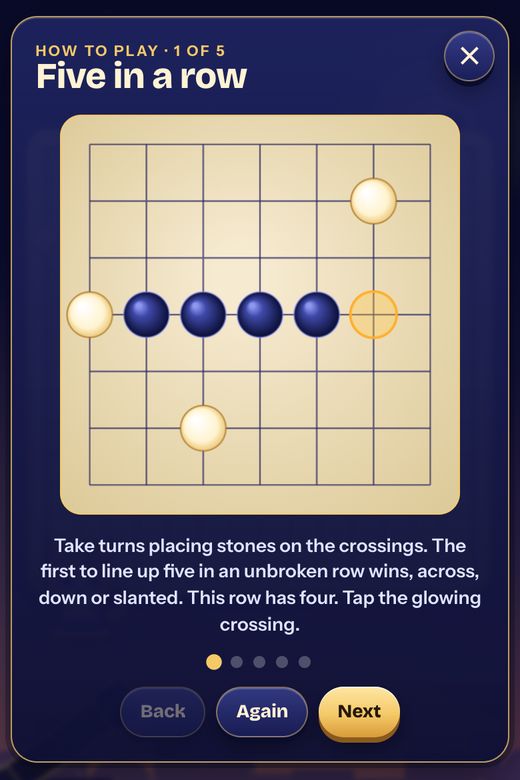 Lesson one on a small board: four in a row, tap the glowing crossing for five.
Freestyle or Standard: which gomoku rules apply?
The only real difference between the two options is what happens with a line longer than five. Starlay lets you pick on the setup sheet.
- Freestyle is the default. Five or more stones in an unbroken row wins, so six or seven count as well.
- Standard wants exactly five. A row of six or more does not count, and Nova will point it out if you make one by accident.
Neither option restricts either colour, so Dark and Light follow the same rule. Names for these variants differ from site to site, so check which one you are playing before you compare notes with a friend. Renju is a third family that bans certain shapes, such as double threes, for the player who moves first. Starlay does not offer it.
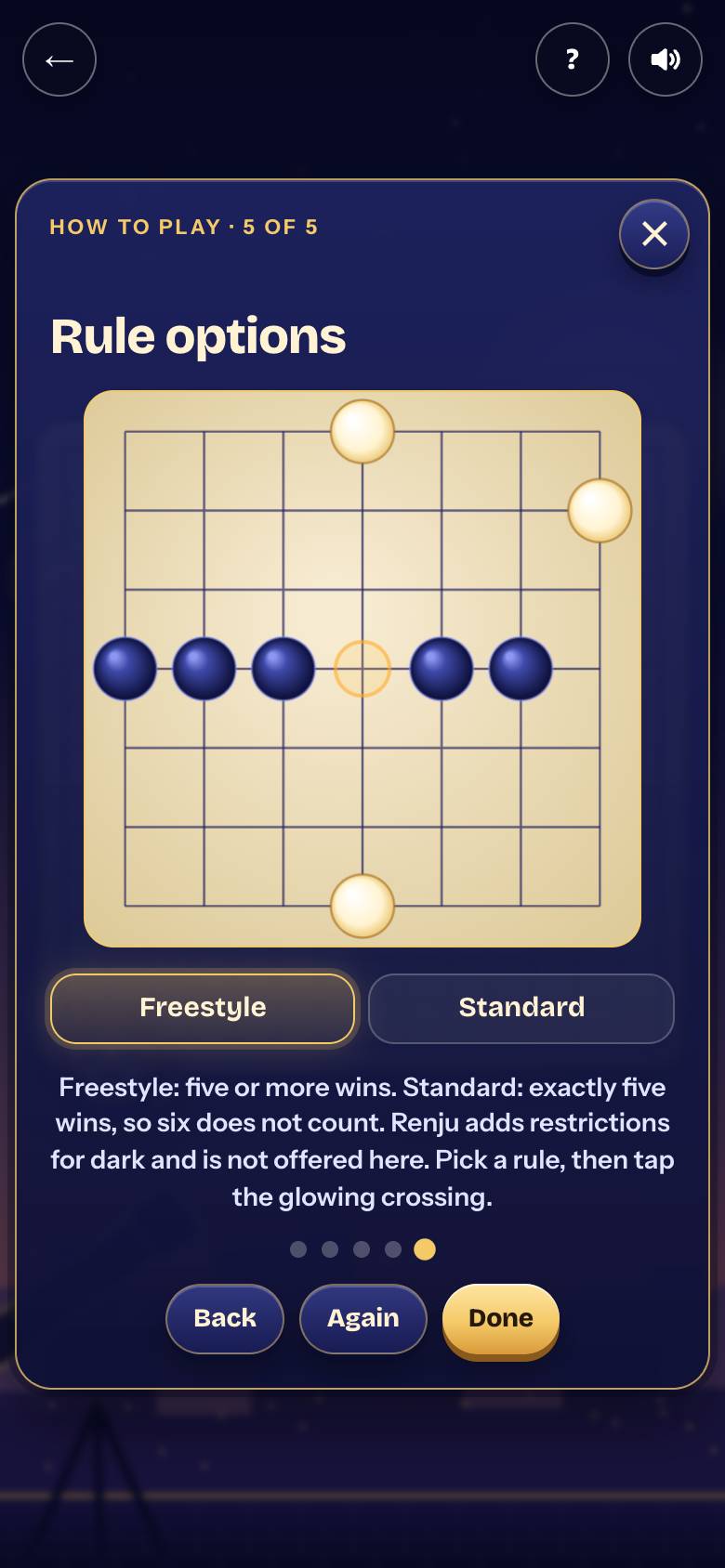 The last lesson lets you try the same move under both rules and see the result.
Threes and fours: the words you will meet
These terms are not extra rules, only the language of the game.
- A three is three of your stones in a line with room to grow.
- An open three has empty crossings at both ends. If you ignore it, it becomes an open four.
- A four is one stone from five and must be answered at once.
- An open four has both ends free. The opponent can block only one, so it wins.
Gaps count too: two stones, a hole, then a third stone is still a three. Lesson two in the game shows the open three on a real board.
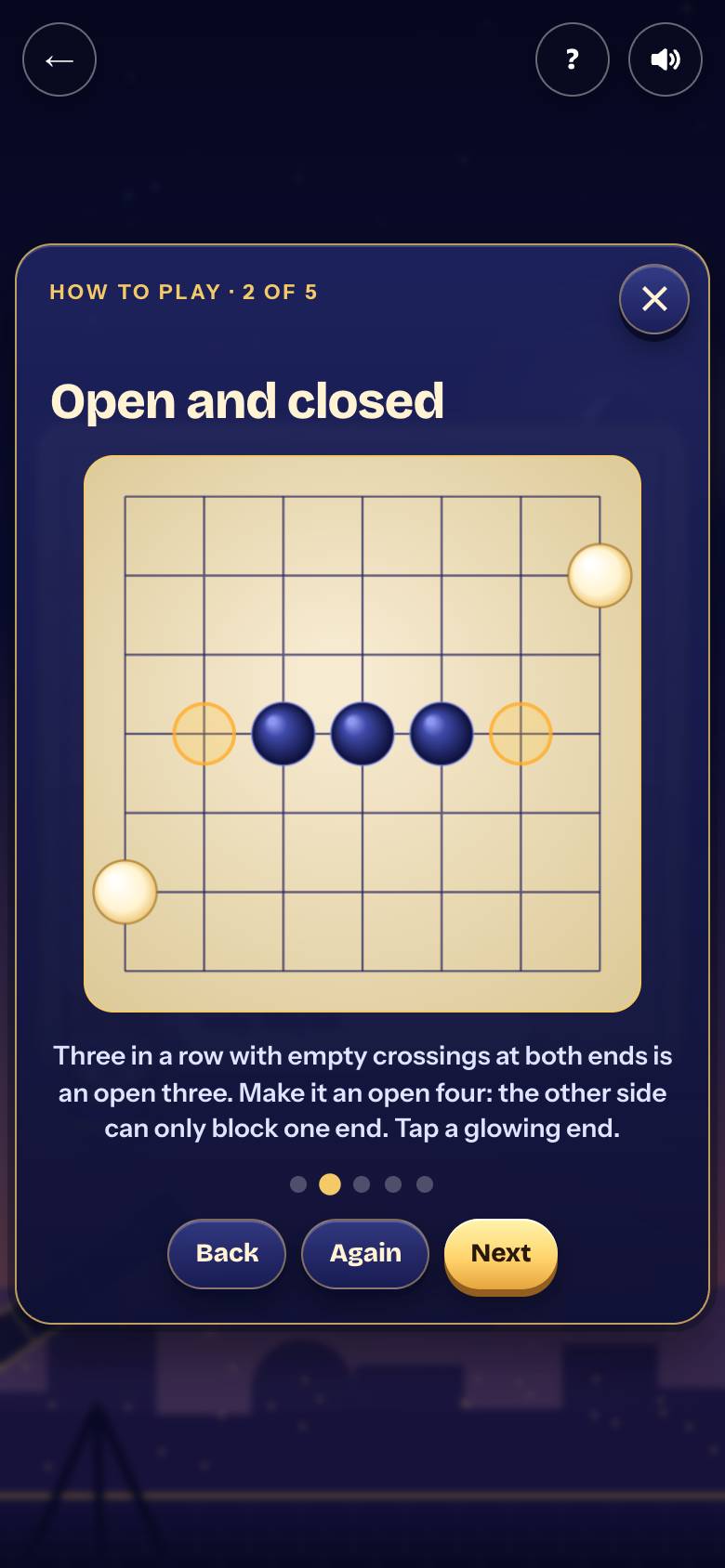 An open three: both ends are empty, so one more stone makes an open four.
Playing the computer or a friend
Against Nova you choose Easy, Medium or Hard. Easy allows free undo and hints. Against Medium and Hard, undo is switched off. Two players can share one device, taking turns on the same board, and may use undo and hints too. Your daily puzzle results, campaign stars and streak are saved in your browser, not on a server.
If you want to practise rather than play a full game, the daily puzzle gives you three win-in-N problems with one winning first move each, and the 44-level campaign teaches each shape in order. Once the gomoku rules feel natural, read the gomoku strategy guide for openings, forks and defence.
Gomoku rules questions
Does a gap break the line of five?
Yes. The five stones must touch each other in one unbroken line, in any of the four directions. A stone of the other colour or an empty crossing inside the line means it is not yet five.
Does the first player have an advantage?
Yes. On a 15x15 board with freestyle rules, the player who moves first can force a win with perfect play, and that result was proven by computer search in the 1990s. It takes deep knowledge to use, so for ordinary games it mainly means Dark should take the centre and Light must defend carefully.
What happens if I make six in a row?
Under Freestyle, six or more still wins. Under Standard, only exactly five wins, so the six does not count and the game goes on.
Is gomoku the same game as Go?
No. They often share a board and black and white stones, but Go is about surrounding territory and capturing stones. Gomoku has no capture and no territory, only the race to five.
What if every crossing fills up?
The game is a draw. On the 15x15 board that means all 225 crossings are taken without five in a row for either side.
Can I learn the rules without playing a full game?
Yes. The five short lessons on this page use a small board you tap, and they cover five in a row, open threes, the threat ladder, two threats at once and the rule options.